

UPSKILLING TOWARDS THE FUTURE
About Skills Bahrain
Constantly evolving labor markets create a skills gap between the local workforce and employers globally. To address this, the Kingdom of Bahrain is making strides to support local talent, drive innovation, and enhance productivity in line with the Economic Vision 2030. One of the steps taken towards this journey was the creation of Skills Bahrain, a national initiative under the Labour Fund (Tamkeen), which focuses on guiding the development of national skills.
Skills Bahrain works closely with employers, education & training providers, and government stakeholders, to bridge the skills gap by providing its stakeholders with the necessary intelligence, sector-specific data, and necessary tools.
Skills Bahrain contributes to the transition from education to employment, and provides a clear path towards career development, therefore ‘developing skilled and globally competitive Bahraini talent’.
0
0
0
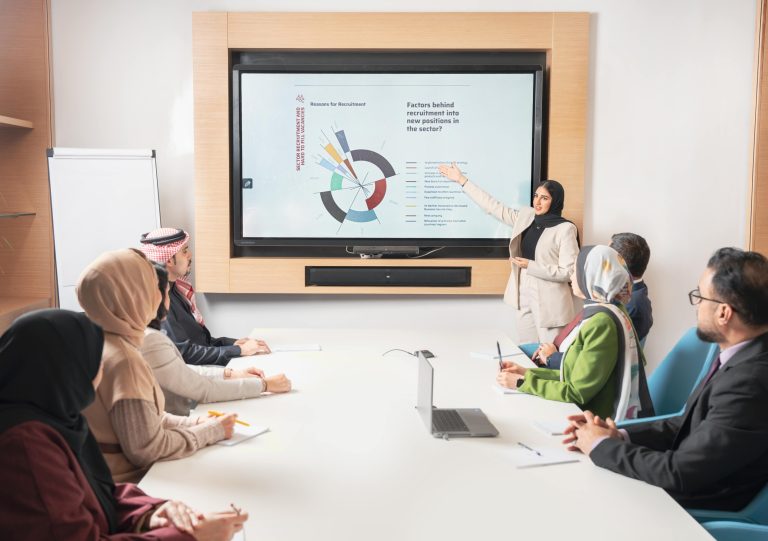
Equipping you with the right information for a better future
Our Objectives
- Recognize the rising demand for current and future skills in the labor market and link them with education and training outputs to increase labor market competitiveness and productivity.
- Support employers and investors in building a pipeline of National skills, allowing them to drive innovation and improve productivity.
- Support the shift from qualification-based evaluation to competency based evaluation for human capital in the workplace.
- Ensure that Employees build rewarding and sustainable careers, actively improving their quality of life.

Our Sectors
“Skills Bahrain” sector-based reports follow evidence-based sector-specific market intelligence to identify current and future labor market challenges and opportunities. Below are the skills reports for the 11 target sectors:
Human Resource
Bahrain’s Human Resources function has evolved over the past decade, the integration of technological advancements and data analytics in Human Resources processes is enhancing recruitment, employee engagement, and performance management, enabling organizations to make data-driven decisions. This shift towards a strategic role is evident in Bahrain’s Human Resources landscape, where the sector is evolving to
Education
The Education sector, including both public and private, holds significant importance to Bahrain’s social infrastructure and ranks as the eighth-largest non-oil economic sector in terms of contribution to real GDP. The education sector accounted for 3.98% of the national real GDP, with a total output of BHD 602.39 million in 20241. The Private Education Sector
Financial Services
The Financial Services sector, including Financial and Insurance activities, is an essential pillar of Bahrain’s national economy. The sector counts as the largest non-oil contributor to Bahrain’s GDP, estimated at BHD 2.4 billion in 2023 – an increase of BHD 130.6 million year-on-year. It also played a key role in attracting BHD 10.7 billion in
Accountancy
Accountancy in Bahrain is a rapidly growing sector that plays a vital role in the country’s economy. The sector is part of the largest non-oil contributor to the national GDP, the Financial Services sector which accounts for 17.8% of the total GDP in 2023 (1.). The Accountancy Sector Skills Report was developed through a comprehensive
Hospitality and Tourism
The Hospitality and Tourism sector in Bahrain holds significant importance as a priority sector contributing to the country’s economy, supporting growth, employment, and economic diversification. Bahrain’s strategic location in the Gulf region, combined with its rich cultural heritage and modern infrastructure, positions it as an appealing destination for both tourists and business travelers. In 2022,
Energy
Worldwide, the Energy sector is amid transformative change, diversifying from traditional fossil fuels to alternative sources, aligning with the global trajectory towards sustainability. Although the sector in Bahrain is still dominated today by oil and gas, there is an accelerated shift towards decarbonization and renewable resources, particularly solar energy. This shift indicates Bahrain’s commitment to
Construction and Real Estate
Our insightful journey for this sector will be shared with you soon.
Transport and Logistics
Our insightful journey for this sector will be shared with you soon.
Manufacturing
Our insightful journey for this sector will be shared with you soon.
Healthcare
Our insightful journey for this sector will be shared with you soon.
Fintech
Our insightful journey for this sector will be shared with you soon.
Retail
Our insightful journey for this sector will be shared with you soon.
FAQs
Skills Bahrain is a labor market intelligence initiative which helps Bahrainis gain the skills they need to succeed in their chosen fields. We inform job-seekers, employees, and decision-makers of the skills demanded by different sectors, while helping to ensure that professionals, current and future, are equipped to succeed in a modern economy.
Skills Bahrain quizzes employers about job trends in their industries, which skills are most in demand, and the areas in which they find it challenging to attract skilled Bahrainis. Armed with this invaluable insight, we work with educational and training institutions, as well as the employers themselves, to ensure these skills are embedded into Bahrain’s training programs. This allows Bahrainis to more easily identify the opportunities available to them and develop the skills they need for success.
Skills Bahrain was created to take a proactive approach in preparing the Bahraini workforce for the future. Countries around the world are grappling with the ‘double disruption’ of automation and digitalization while rebounding from the impact Covid-19 has had on business. We recognise the importance of better preparing new entrants to the workforce and rapidly upskilling those already employed, which is why we have created frameworks for identifying and quantifying the most important work-related skills. This will ensure that our nation’s investment in training and education is channelled in the most effective direction.
Skills Bahrain supports every Bahraini citizen who currently has a job or is looking to have one in the future, along with education and training providers, employers across all major sectors, and policy makers.
- Individuals benefit from having access to up-to-date information about career pathways, wages, and high growth private sector jobs, helping them to make better informed career choices.
- Education and training faculty members gain valuable intelligence which will help them design curricula suited for the skills most in demand.
- Employers and managers have national standards to refer to for specific skills and jobs, which can be used for improved performance management, training, and learning and development.
- Finally, Skills Bahrain empowers policymakers who need accurate labor market information to better inform national investments in education and training.
Skills Bahrain was set up through a partnership that includes most Bahrain government ministries. This was facilitated by the Supreme Council for the Development of Education and Training (SCET) at the office of HRH the Crown Prince and Prime Minister, Prince Salman bin Hamad Al Khalifa. It was decided that Skills Bahrain will be incubated within Tamkeen during its pilot and development phases. Skills Bahrain’s key stakeholders are job seekers, employees, private sector employers, Tamkeen, the Ministry of Labor, and all government ministries and agencies with an interest in skills.
Skills Bahrain is there at every stage of the journey to employment, supporting parents and students by providing information about what career options are available and what skills are most in demand, while offering guidance with important life decisions. By providing access to up-to-date information about career pathways, wages, and jobs in the private sector, Skills Bahrain can help students make better informed career choices.
Skills Bahrain’s Sector Skills Studies outline the specific skills that employers across Bahrain’s key sectors are looking for. This information helps employees identify the skills they need to move into, across, and up within a sector. Skills Bahrain also works in partnership with education and training providers to develop alternative learning pathways, such as apprenticeships, to support Bahrainis wishing to enter a particular profession through unconventional means.
The Career Pathway Tool provides critical information on the skills, education levels, and training needed to be successful in a particular sector. If you are a student, this information can help you make better informed career choices. If you are currently employed, it will help you understand what you need to do to move to another role within your sector or across to another industry.
A National Occupational Standard (NOS) is a set of that outlines a specific job or occupation. It provides an official description of the profession and its key functions; what core skills, technical skills, and behaviors are needed and at what levels; the career routes into and up from the job; the education and training required; any regulations or licensing requirements; and, most importantly, what training standards apply to the job.
This provides a single point of references to better inform learning and development programs by employers and education and training providers. It also clearly outlines what employees and job seekers need to do to succeed in a particular profession.
Workforce planning is like human resource planning, but on a national scale. It is about identifying a sector’s growth requirements, so that it can better contribute to the national economy.
Markets with well developed labor market intelligence can predict which areas of the economy will need skills development, as well as those in decline. Policy-makers can then adjust education and training investment to focus on priority areas, helping to match labor market supply with demand. The research we are gathering is helping us plan for the skills of the future and ensure education and training is able to keep up.
A Skills Framework is a grouping of skills used to describe the needs of a sector or occupation.
Groupings, such as “Employability Skills” or “21st Century Skills”, are generally well catered by Bahrain’s education and training providers. Many of these Frameworks, such as ‘Critical Thinking’, are core to all sectors, while others are sector specific, such as ‘Health and Safety’ for the construction sector or ‘Finding and Using Data’ for the financial services sector.
We at Skills Bahrain have identified certain sector specific skills that are expected to have the greatest contribution to future growth, and are deserving of their own Frameworks. We are working to build Frameworks for core skills relevant to these high impact sectors, including a range of technical skills, transferable skills, soft skills, and behaviours.
These are tools/means to help employees become better equipped to succeed in their professions:
- Skilling ensures that people have the skills and abilities necessary to perform the tasks required by their jobs.
- Upskilling means enhancing or building on existing skills, for example, updating an employee’s existing technology skills.
- Reskilling refers to learning a new skill, which is becoming more important as new job requirements are being introduced to the market.
Currently, Skills Bahrain is incubated within Tamkeen.
Skills Bahrain has just completed its inaugural Sector Skills Studies of the Financial Services and Telecommunications sectors. This research is helping us to find the best ways to upskill and reskill individuals as professions in those industries continue to evolve and grow. With work-based learning being a core principle of the Skills Bahrain initiative, national standards will be created to support talent development in these sectors.
Research is now being initiated across other industries, for which similar reports are expected to be published next year.
All the publications offered by Skills Bahrain, including Sector Skills Studies, Skills Frameworks, Career Pathway tools, Skill Level Descriptors, National Occupational Standards, and various thought leadership papers are available to the general public without any fee required. Skill Bahrain’s goals are to help the private sector grow and enhance the productivity of the labor market. Seeing our Kingdom thrive and succeed is all the payment we need!
Our Partners




Our Offerings
Human Resource
Bahrain’s Human Resources function has evolved over the past decade, the integration of technological advancements and data analytics in Human Resources processes is enhancing recruitment, employee engagement, and performance management, enabling organizations to make data-driven decisions. This shift towards a strategic role is evident in Bahrain’s Human Resources landscape, where the sector is evolving to
Education
The Education sector, including both public and private, holds significant importance to Bahrain’s social infrastructure and ranks as the eighth-largest non-oil economic sector in terms of contribution to real GDP. The education sector accounted for 3.98% of the national real GDP, with a total output of BHD 602.39 million in 20241. The Private Education Sector
Global Commodities Trading
Solving social problems requires leaders from foundations, businesses, and governments to reimagine the systems and relationships that shape our world.
Contacts
-
Bahrain Chamber of Commerce and Industry Building, Tamkeen
6th floor -
+973 17383333
-